
In this article
Keep the 3 Bucket Rule visible and in mind.
The 3 Bucket Rule is a simple way to sort your worries into three groups: what you can control, what you can influence, and what you may need to let go.
Print a copy for your desk, frame it for your wall, or share it at your workplace.
Sizes A3 A4 A5
Download your FREE poster here.
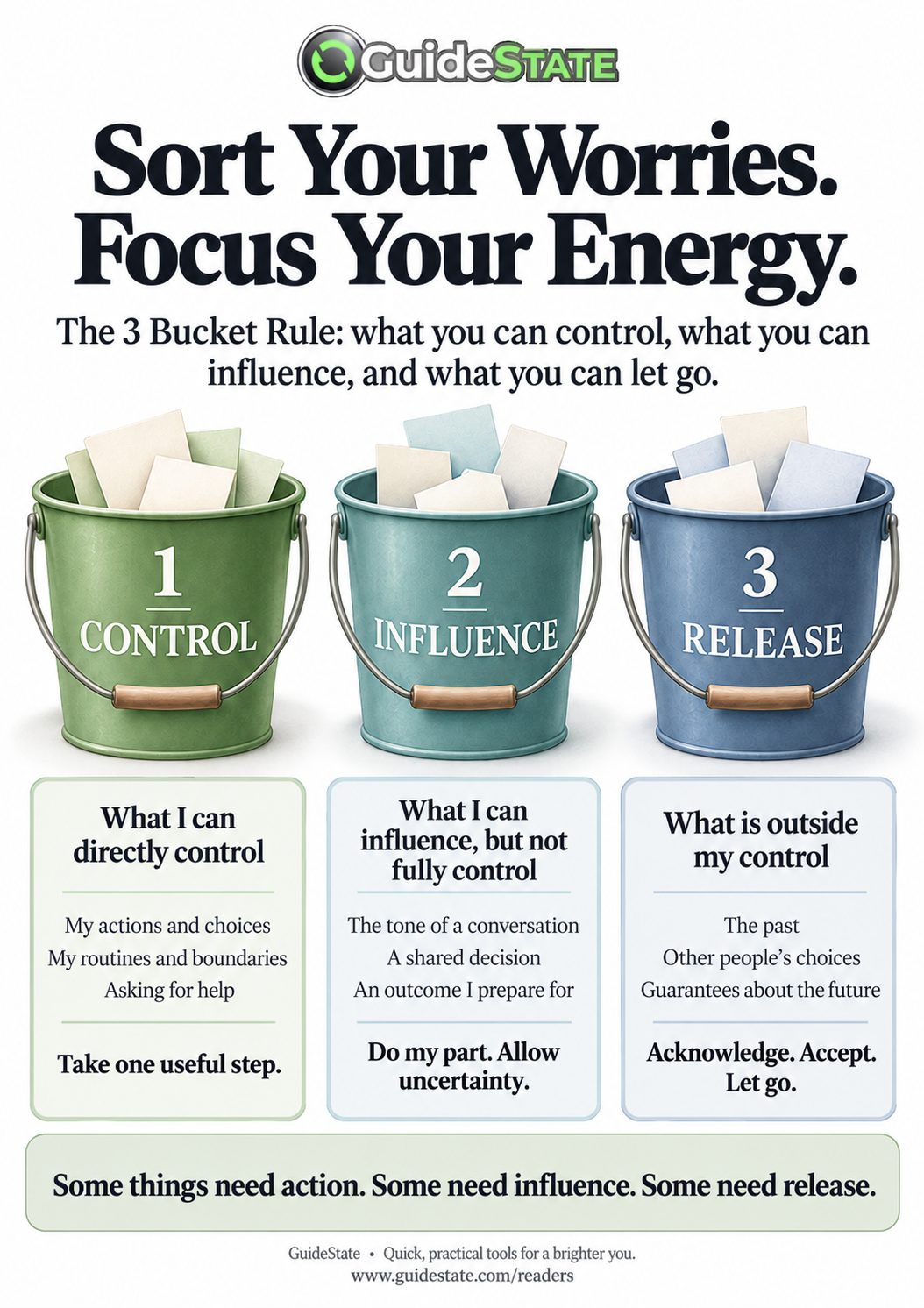
The 3 Bucket Rule: What to Control, Influence and Let Go
Sort your worries. Focus your energy.
Sometimes the hardest part of a full mind is that everything seems to belong to you.
The task you need to finish. The conversation that went badly. Someone else’s disappointment. A decision you are waiting for. Something that might happen next month.
They arrive together, even though they ask very different things of you.
Some need action. Some need a conversation. Some cannot be changed, however many times you think about them
The 3 Bucket Rule is a simple way to sort your worries into three groups: what you can control, what you can influence, and what you may need to let go.
Then you can ask a more useful question:
Where can my energy help now?
What is the 3 Bucket Rule?
The three buckets represent different relationships with a situation.
- Control: the actions and choices that are available to you.
- Influence: things your contribution may affect, without determining the result.
- Release: what you cannot change or guarantee, and may need to acknowledge and accept.
Think of them as a practical sorting exercise. You do not have to find a perfect category for every concern before doing anything useful.
The aim is to recognise where you have a next step, where you can make a contribution, and where further effort is becoming an attempt to control the uncontrollable.
Bucket 1: What I can directly control
Start with what is genuinely available to you in the circumstances you are in.
You might be able to send an email, ask a question, prepare for a meeting, set a boundary, or ask someone for help.
You might be able to choose the next small action, even when the whole task feels beyond you.
This bucket includes things such as:
- The words you choose to put in a message.
- Whether you ask for clarification before making an assumption.
- The preparation you do with the time and resources you have.
- A boundary you communicate and the action you take to uphold it.
- Making room for a break or seeking support.
Be realistic about the word control. Your energy, health, resources and responsibilities affect what is possible. You cannot always choose your first thought or immediately change how you feel.
A useful next step may be very small.
Ask: What is one thing I can actually do here?
The reminder for this bucket is:
Take one useful step.
Bucket 2: What I can influence, but not fully control
Some things respond to your effort without belonging entirely to you.
You can contribute to the tone of a conversation. You can explain your needs. You can prepare carefully for an interview. You can suggest a different way of working.
Your contribution matters. Other people and circumstances also have a part in the result.
This bucket includes things such as:
- How a discussion develops.
- A shared decision.
- Whether someone understands your point of view.
- An outcome you prepare for.
- A change you ask others to support.
The difficult part is knowing when you have made a reasonable contribution.
You may have explained clearly, listened carefully and followed up appropriately, yet still find yourself mentally rehearsing another way to secure the answer you want.
At that point, ask: Is there another useful contribution I can make, or am I asking effort to provide a guarantee?
The reminder for this bucket is:
Do my part. Allow uncertainty.
Bucket 3: What is outside my control
Some parts of life cannot be changed by your present effort.
The past has already happened. Other people make their own choices. No amount of preparation can guarantee every future outcome.
Recognising these limits can be uncomfortable, especially when something matters deeply.
This bucket includes things such as:
- What has already happened.
- Another person’s final decision.
- Whether everyone approves of you.
- Having certainty about the future.
- Events you have no realistic way to affect.
Acceptance can begin with a simple acknowledgement: This is the situation I am facing.
You can then consider what response remains available. You may need to protect a boundary, seek support, make a different plan, or give yourself time to feel disappointed.
Putting something in this bucket does not require you to approve of it or remain in a harmful situation. It helps separate the fact you cannot change from the response you may still be able to choose.
The reminder for this bucket is:
Acknowledge. Accept. Let go.
Letting go may be something you practise repeatedly. A returning worry does not mean you have failed the exercise.
One worry can contain all three buckets
Suppose you are worried about a difficult conversation with a colleague.
You might initially place the whole situation under “I need to sort this out”. That gives you responsibility for much more than your own part.
Separating it reveals something more manageable.
What you can control: preparing the points you want to raise, choosing respectful wording, and being clear about what you need.
What you can influence: the tone of the discussion, whether you reach a shared understanding, and the possibility of an agreement.
What you cannot control: the colleague’s first reaction, their private opinion, or whether they agree with everything you say.
You can prepare for the conversation while allowing the other person to have their own response.
The practical distinction is between your contribution and the result. Your preparation belongs in the first bucket. What it may help bring about belongs in the second. A guaranteed outcome belongs in the third.
How to use the rule when your mind feels full
Begin with one concern. You do not need to sort your whole life at once.
- Write it down plainly. For example: “I am worried that my request will be refused.”
- Separate the parts. What can you do? What might your effort influence? What cannot you decide for someone else?
- Choose one useful action. Make the request clear, provide the relevant information, or decide when a follow-up would be reasonable.
- Name what remains uncertain. “I cannot choose their answer.”
- Return to what is in front of you. Let your next activity have some of the attention the worry has been taking.
If something needs reviewing later, choose a time or a clear reason to revisit it. That gives the concern a place without requiring you to keep checking it mentally.
You can change a category when circumstances change. New information may reveal an action you had not seen before.
Notice the state you are sorting from
Before using the buckets, pause long enough to notice how you are approaching the exercise.
Are you hurried? Tired? Frustrated? Trying to prevent anyone from being disappointed?
When you feel under pressure, you may put too much in the first bucket: I have to fix all of this.
When you feel defeated, you may put too much in the third: There is nothing I can do.
Either conclusion deserves a second look.
Give yourself a little space if you can. Step away from the screen, sit somewhere quieter, or talk the situation through with someone you trust.
You do not need to feel perfectly calm before taking action. The invitation is simply to notice whether your current state is affecting your judgement about what is possible.
Use the buckets with care
This is an exercise to use with yourself, and an invitation you can offer to someone else.
A person who is upset may need to be heard before they are ready to sort anything. Telling them to “put it in the release bucket” can close a conversation they needed to have.
A gentler question is:
Would it help to look together at which parts you can do something about?
The same care applies at work. A poster can prompt reflection, but people still need opportunities to raise concerns, ask for help and address practical problems.
The GuideState route
Start by understanding what you are carrying and noticing the state you are thinking from.
Then create enough space to look at the concern more clearly.
Use the buckets to distinguish the action available to you, the contribution you can make, and the uncertainty you may need to live with.
Finally, decide what matters next.
Sometimes that will be an action. Sometimes a conversation. Sometimes it will be allowing a matter to rest until there is something useful to do.
The exercise brings the GuideState approach into an ordinary moment: understand your state, think things through, and choose your next step with greater awareness.
Keep the 3 Bucket Rule nearby
The accompanying poster offers a quick reminder of the three questions:
What can I control? What can I influence? What can I let go?
Keep it somewhere you are likely to notice it when your mind feels full: beside your desk, in a shared office, or in a reception or waiting area.
Download your FREE poster here.
Return to one concern and one useful next step.
A quiet closing thought
Caring about something can make it difficult to recognise where your responsibility ends.
You can care deeply, contribute thoughtfully, and still leave room for an outcome you cannot decide.
Some things need action. Some need influence. Some need release.
Of everything you are carrying today, which part is asking for one useful step — and which part are you trying to guarantee?